
Green tile floors set on prep, not on hope.
Porcelain, ceramic, and stone tile flooring for Green homes, set over a flattened, properly prepped substrate so nothing lippages, cracks, or lifts, by the two owners of Stark Elite Home Solutions.
The substrate decides the floor. We treat it that way.
Tile flooring in Green is one of those jobs where the finished look and the long-term result are decided entirely by the part nobody sees: what is under the tile. Stark Elite Home Solutions sets porcelain, ceramic, and natural stone floors in kitchens, baths, mudrooms, laundries, and entries, and Brian came up through commercial hard-surface and high-end tile work, so the prep gets the attention it deserves before the first piece is set.
What a Green tile floor costs is a function of the tile, the pattern, and how much work the subfloor needs before it is ready. Large-format porcelain, herringbone and other layout patterns, and natural stone sit at the top of the range; a straightforward ceramic in a small bath sits at the bottom. We measure the real job, prep included, and put one fixed number on paper before work starts, so nothing about the price is a moving target once demo begins.
The failures homeowners see with tile, cracked pieces, hollow spots, grout lines that break loose, come almost entirely from skipped prep. Tile is unforgiving of a subfloor that flexes or is not flat. We flatten and level the substrate, add the right underlayment or crack-isolation membrane for the situation, and confirm deflection is within spec before a single tile goes down. A floor built on that lasts decades; a floor built on a bad substrate telegraphs every problem beneath it.
Green’s newer housing stock changes the prep conversation, not the need for it. The 1990s and 2000s builds around Massillon Road and Arlington Road mostly stand on OSB subfloors and open-web or I-joist framing, which are flat when they are dry and stiff enough on paper, but long joist spans and a generation of humidity cycles mean we still check flatness and deflection on every job instead of assuming the builder’s math holds today.
Layout matters as much as prep. We dry-lay and plan the field so the cuts land where they should, borders line up with the walls, and the pattern reads deliberate rather than started-from-a-corner-and-hoped. In a Green kitchen, mudroom, or entry that means the tile references the cabinetry, the transitions, and the room, not just the first course.
Mudrooms and entries are where tile earns its keep in this climate. A Green winter drags snowmelt, salt, and wet boots across the same six square feet of floor from November to March, and porcelain is the one surface that takes that abuse without complaint. We detail those wet zones with the slope, the sealant, and the transitions to handle winter water instead of letting it sit against baseboards.
Same as every job we run, you deal with the same two people the entire time. The person who quoted your Green tile floor is the person prepping the substrate and setting the tile. That is why our work comes largely from neighbors of people we have already built for.
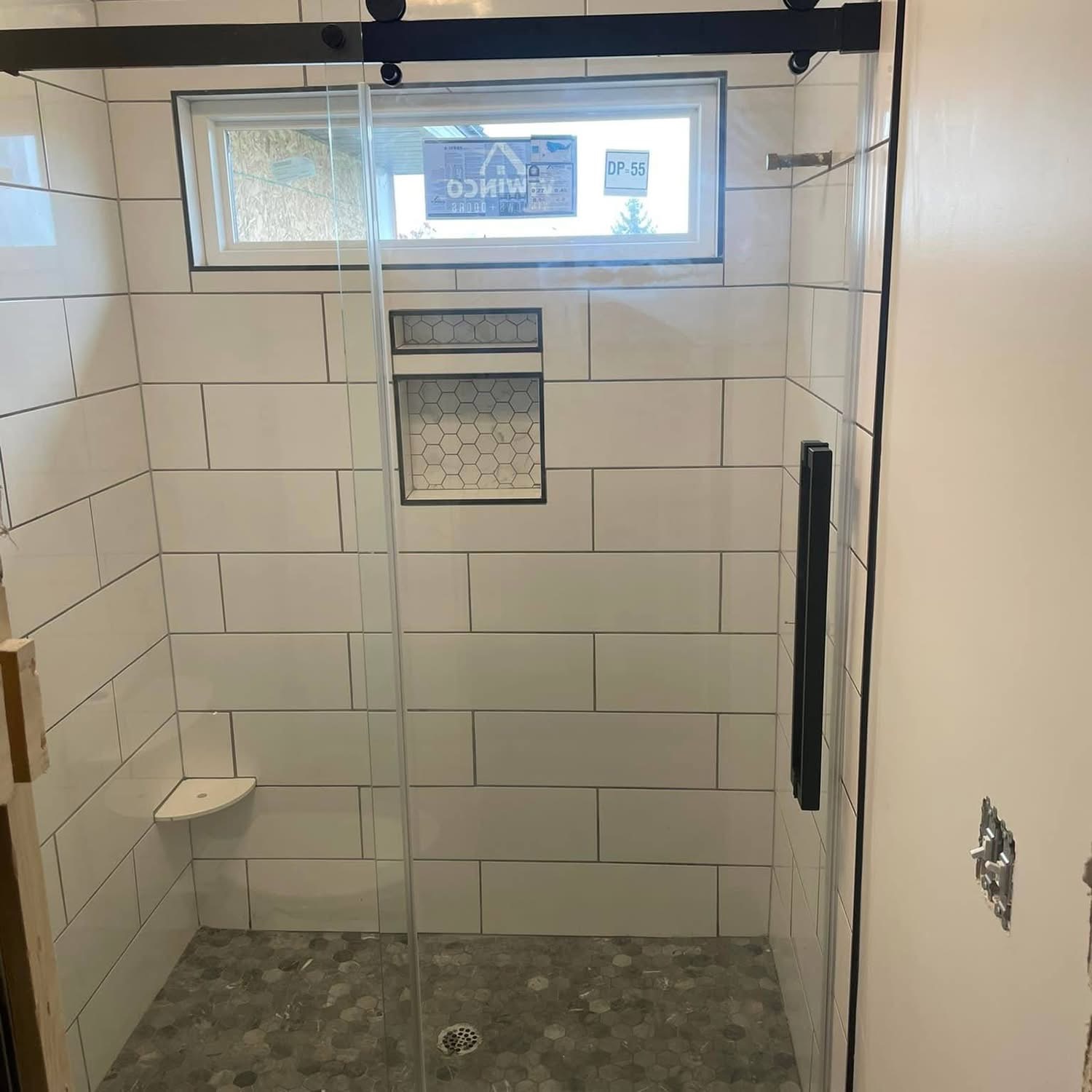
A tile floor in a Green home lives or dies on what is underneath it, and newer construction does not get a pass on prep.
The tile floors that fail in Green kitchens, entries, and baths almost never fail because of the tile. They fail because they were set over a subfloor that flexed, was not flat, or was never prepped for the material on top of it. Cracked pieces, hollow spots, and grout lines that break loose all trace back to that one shortcut, and it is the first thing we rule out on every job.
Green’s 1990s and 2000s builds mostly stand on OSB and engineered joists rather than the plank subfloors we open up in older towns, and that cuts both ways. The floors are flatter to start, but long open spans can bounce more than a dimensional-lumber floor ever did, and bounce is what breaks tile. We check flatness and deflection on every Green floor, stiffen or flatten what needs it, and add the right membrane before anything gets set.
Current selections lean hard toward large-format porcelain and wood-look plank tile, and both are less forgiving of a bad substrate than a small ceramic ever was. A large tile spans more floor, so any dip underneath shows up as lippage or a cracked corner. Prep is not the boring part of the job; it is the part that decides whether the floor still looks new in fifteen years.
Layout is the other half. We dry-lay the field so cuts land where they belong, borders line up with the walls, and the pattern references the cabinetry and transitions rather than a random starting corner. In a Green mudroom taking a winter of boots and salt, that difference is the line between a floor that looks installed and one that looks designed.
Every tile floor gets the same standard: a fixed written scope including prep, the two owners on site, and a floor set flat with full coverage under each piece. The gallery has recent tile work, and a call gets you a measure and a real number.
The same workflow on every Green job.
In-home consult
We measure the floor, check the subfloor for flatness and deflection, and lay out tile and pattern options against a real budget. Any prep the substrate needs gets identified now, not later.
Fixed written scope
Tile, pattern, prep and membrane, grout, transitions, and the schedule all go on paper before work starts. The price holds unless you change the plan.
Substrate prep
The step that decides everything. We flatten and level the substrate, address deflection, and add the right underlayment or crack-isolation membrane so the finished floor has something solid and true to sit on.
Dry-lay & layout
We plan the field so cuts land where they should and the pattern lines up with the room. In a kitchen or entry the tile references the cabinetry and transitions, not just a starting corner.
Set & grout
Tile set flat with full coverage under each piece so there are no hollow spots, then grouted and cleaned to consistent lines. Transitions and thresholds finished so height changes between rooms are clean.
Walkthrough & punch list
We walk the finished floor with you, build the punch list on the spot, and close every item before final payment. Cleanup and haul-off are part of the job.
Questions Green homeowners ask.
How much does tile flooring cost in Green?
Why do tile floors crack, and how do you prevent it?
Can you tile over my existing floor?
Is tile a good choice for Green mudrooms and entries?
How long does a tile flooring job take?
Are you licensed and insured for work in Green?
Free tile flooring quote in Green.
Call and we will come out to your Green home, measure, and write a real scope. No deposit, no pressure. See finished work in our gallery or request the quote.