
Hudson tile set on a floor that will hold it.
Porcelain, ceramic, and natural stone floors for Hudson homes, set only after the subfloor underneath has been flattened, stiffened, and decoupled. Two owners on site, start to finish.
Prep decides everything. The tile is the easy part.
Hudson has a housing stock that punishes shortcuts. The homes around the Green were framed when subfloors were plank decking laid straight across the joists, and a hundred and some winters later those planks have dried, cupped slightly, and learned to move a little with every heating season. Tile has zero tolerance for that. Set it on wood that shifts and the grout lines hairline first, then a tile corner pops, and eventually you have a floor with a sound you can hear when you walk it. Brian spent years in commercial hard surface work before moving into high-end residential tile, and the habit that came with him is simple: nobody sets a tile until the floor underneath is right.
What “right” means changes house to house. In a newer build off Barlow or Hines Hill the joists are engineered and the deck is plywood, so we may only need to flatten a few low spots and check deflection. In an older place near downtown, right often means adding a layer to stiffen the floor system, screwing off the plank decking, correcting the dips, and then bonding a decoupling membrane so the tile and the wood below are no longer married to each other. That membrane is a thin layer with a structure that absorbs small movement instead of passing it up into the tile, and on plank subfloors it is the single best money you can spend on a tile job.
Mudrooms and entries built for the salt season
Hudson winters are hard on the first ten feet inside a door. Road salt, slush off boots, wet dog, and grit that acts like sandpaper all land in the same square yard for four months. Tile is the right answer there, but only the right tile with the right grout. We steer mudrooms and entries toward a through-body porcelain where the color runs all the way through the piece, so the traffic path never wears to a different shade the way a glazed tile eventually does. Then we use a high-performance grout rather than a standard cement one, because road salt stains ordinary grout and no amount of scrubbing takes it back out.
The details that make a mudroom survive are unglamorous and they matter: a threshold detail that keeps meltwater from tracking into the hardwood in the next room, a slightly larger grout joint on a textured tile so it can actually be cleaned, and a slip rating you can trust in socks. If the mudroom is part of a bigger project, it ties into what we do on a full Hudson kitchen remodel, benches, lockers, and floor as one plan.
Heated floors, and why buyers here notice
Porcelain or stone, honestly
Porcelain wears harder, shrugs off salt and boots, and never needs sealing. Stone brings a depth porcelain cannot fake but wants sealing and gentler care. We lay both, and we will tell you plainly which fits your household.
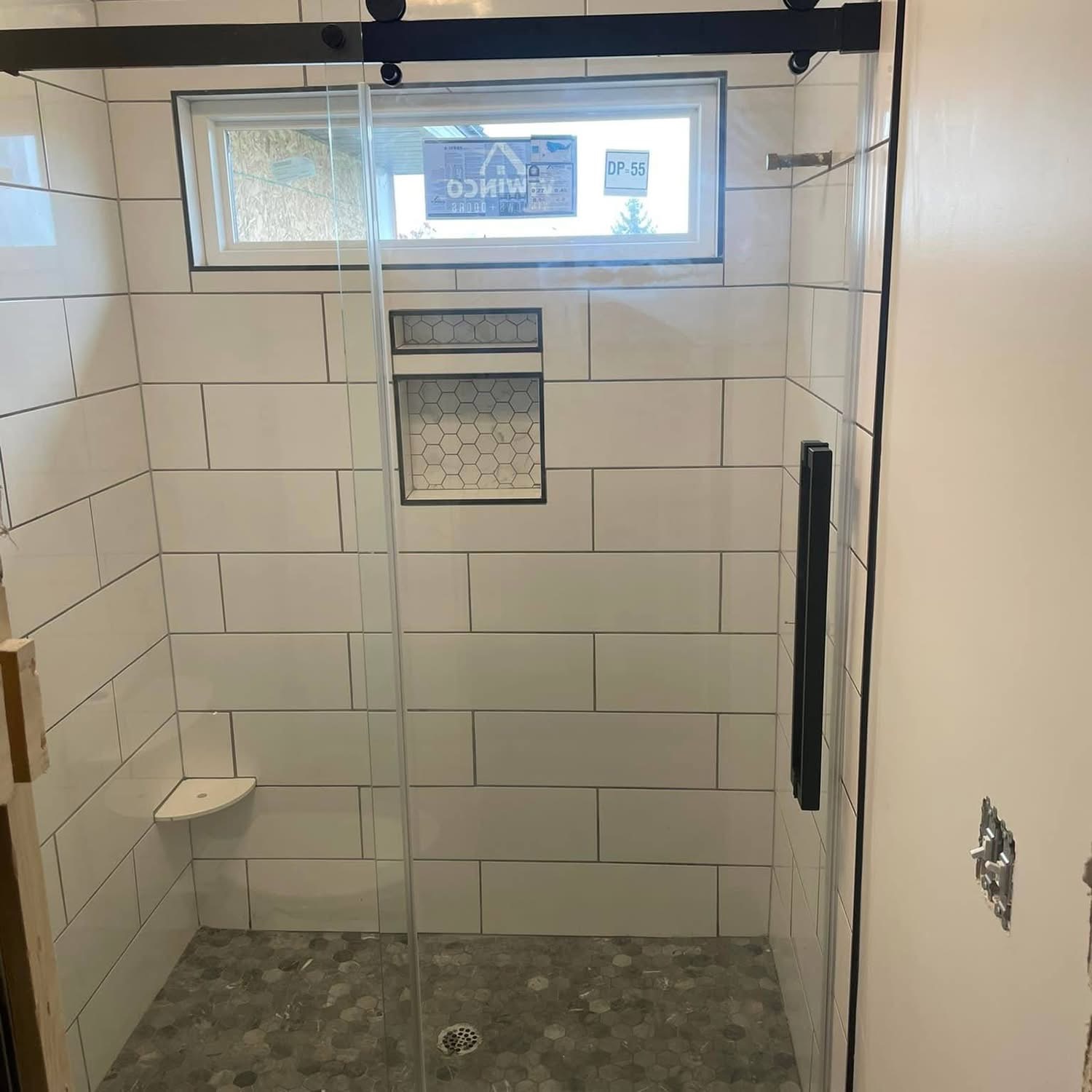
Old plank subfloors move with the seasons. Tile does not move at all. Everything we do before setting day is about that conflict.
Fixing it is not complicated, it is just work nobody sees. We screw off loose decking, add stiffness where the deflection numbers ask for it, flatten the dips with a self-leveler, and bond a decoupling membrane over the top. From that point the tile is floating on a surface that stays true no matter what the joists do underneath. It is the reason a floor we set looks the same in fifteen years as it did the week we finished.
Large-format porcelain has taken over Hudson kitchens and baths, and it is far less forgiving than the small ceramic squares it replaced. A big tile spans more floor, so any dip that a six inch tile would have bridged becomes visible lippage or a cracked corner on a twenty four inch one. The bigger the tile you want, the more the prep matters.
Tile flooring often shows up as one piece of a larger job here. It runs under a custom bathroom remodel, sets the floor of a walk-in shower, and anchors a finished basement where slab moisture is its own conversation. Everything we do in town is listed on the Hudson service page.
Every floor gets the same treatment: a fixed written scope with the prep spelled out, the two owners on site doing the work, full mortar coverage under each piece so nothing sounds hollow, and clean consistent grout lines. Recent work is in the gallery, and a call or message gets a measure and a real number.
The same workflow on every Hudson floor.
Floor assessment
Straightedge and level on the real floor. We map the low spots, check how much the joist system moves, and find out what the decking actually is before anyone talks tile.
Selections that fit the room
Porcelain or stone, size, finish, grout color and type, and whether heat mats belong in this room. A mudroom and a powder room get different answers on purpose.
Fixed written scope
Prep, membrane, heat, tile, grout, transitions, and the schedule go on paper before demo. The price holds unless you change the plan.
Prep and decoupling
Decking screwed off, stiffness added where it is needed, dips leveled, heat mats laid in, then the decoupling membrane bonded down. This is the step the floor’s whole life depends on.
Dry lay and setting
We plan the field so cuts land where they belong and the pattern reads off the cabinetry and doorways. Then tile goes down with full coverage underneath, no hollow spots.
Grout, transitions, walkthrough
Grouted and cleaned to consistent joints, thresholds finished so height changes between rooms are tidy, then we walk it with you and close the punch list before final payment.
What Hudson homeowners ask us.
Why does tile crack in an older Hudson house?
What is a decoupling membrane, and does my floor need one?
Is tile a good choice for a mudroom that takes Ohio winters?
Are heated tile floors worth doing here?
Porcelain or natural stone for a busy family?
Free tile flooring quote in Hudson.
We come out, put a straightedge on the floor, and write a scope that includes the prep. No deposit, no pressure. See finished work or ask for the quote.