
Big tile shows every dip in an old floor.
Porcelain and ceramic floors for East Canton kitchens, baths and mudrooms, laid over framing we have checked and straightened first, with the grout lines planned around the walls your house actually has.
Large tile on an old floor is a flatness problem.
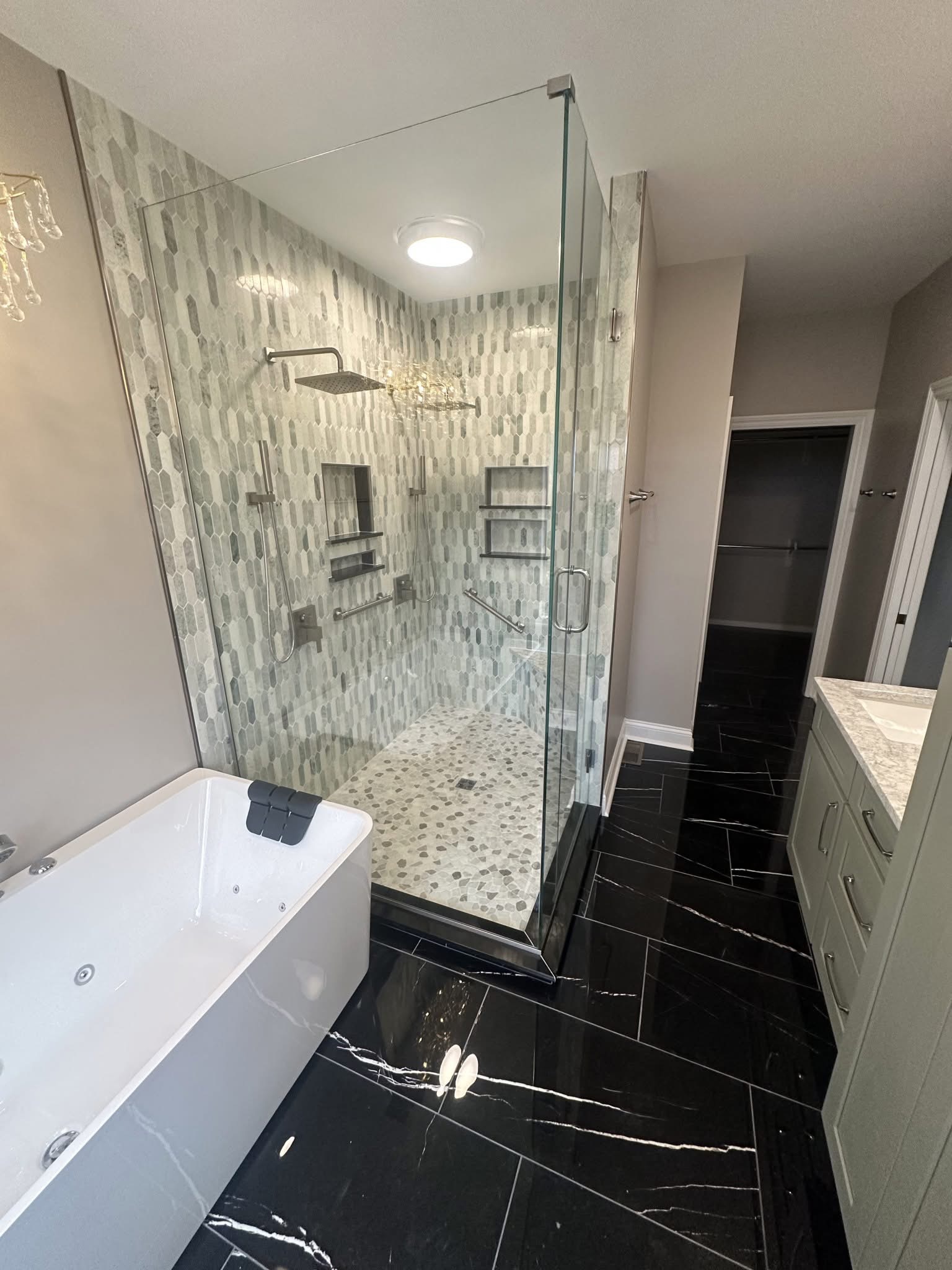
Most of the tile people pick today is big. Twelve by twenty-four, two feet square, sometimes larger, like the black marble-look porcelain in the photo on this page. It looks sharp, and it is brutally honest about the floor under it. A small ceramic square can ride over a gentle hump. A long piece of porcelain cannot bend, so it bridges the low spot, rocks on the high one, and leaves an edge sitting proud of its neighbor. That raised edge is called lippage, and once the thinset cures, it stays.
East Canton has plenty of houses that were built to last: classic frame homes and ranches, many of them decades old. Joists that have carried a household for decades settle a little, sag a little between bearing points, and pick up a crown here and there. Nobody notices under carpet or old sheet vinyl. Pull that up, lay a long straightedge across the subfloor, and the floor tells you everything.
So Brian starts with the straightedge, before anyone talks about color. His start was commercial hard surface work, where flatness gets checked against a tolerance instead of eyeballed. We mark the high spots and the low ones, look at the framing from the basement where we can get to it, and decide what the floor needs. It is usually one of these:
- A joist sistered where it has dropped
- A crown planed down
- A leveling pour across the whole room
- Nothing at all, when the floor is already flat enough
Stiffness still matters. A floor that bounces when you cross it will crack grout no matter how flat it is, and we check for that too. On older houses, though, the thing that ruins large-format tile is usually shape. It is the part people skip, because it takes time and it does not show up in the finished photo. It shows up everywhere else, every time light comes across the floor at a low angle.
Every bit of that prep is written into the scope before we start. You read it as a line item on your free quote, which beats hearing about it halfway through the job with the old floor already in the dumpster.
Older rooms are rarely square, and a grout line will tell on them.
A grout joint is a straight line drawn across your floor, repeated every foot or two. Run that line alongside a wall that drifts out of true and your eye catches it right away, even if you could never say why the room looks a little off. Rooms move out of square as houses settle, and in a house that has been added onto and patched over the years, the walls rarely agree with each other.
We measure the room corner to corner before we plan a single row. Then we decide where the error goes. Usually the wall you see from the doorway gets full or nearly full tiles along it, and the taper hides under a cabinet toe kick, behind a vanity, or along a wall where a couch or a bench will sit. It is a decision we make with you, standing in your room, before any thinset gets mixed.
Grout color belongs in the same conversation. A grout close to the tile color quiets the grid and lets the floor read as one surface, which is forgiving in a room that is not perfectly square. A contrasting grout, like white joints on dark tile, draws the grid on purpose. That can look great, and it shows every line, every taper, and in a kitchen or a mudroom, every bit of dirt that settles into the joints.
Joint width follows the tile. A rectified porcelain with crisp, consistent edges can take a tight joint. A pressed ceramic with some size variation needs more room, or the lines start to wander across the floor. We lay a few pieces out dry on your subfloor so you can see the joint before you commit to it.
Tile asks very little of you in an Ohio winter, but a couple of habits help. Wipe up the road salt that tracks in so it does not dry into a haze on the grout, and keep a mat at the door to catch grit before it gets ground in. If the room sits over a cold crawl space or an unheated porch, tell us, because cold coming up through a floor is worth dealing with before the tile goes down.
Asked at the kitchen table.
Is my older floor too uneven for large tile?
Porcelain or ceramic for a mudroom?
Where do the cut tiles end up?
How do you handle the doorway into a hardwood room?
Will a tile floor feel cold in an Ohio winter?
Can you tile right over my old vinyl floor?
Which tile goes in which room.
Kitchens
Porcelain is our usual pick. It is dense, it takes a dropped pan better than most ceramic, and a color that runs through the body of the tile hides a chip. We plan the floor with the cabinet layout so toe kicks and appliance heights come out right.
Bathrooms
Either one works on a bath floor. Ceramic comes in more patterns and small sizes. Porcelain gives you the large marble-look pieces. Wherever wet feet land, we steer you toward a matte or textured finish over a polished one.
Mudrooms and entries
Slush, salt and grit come in on boots from November on. Porcelain handles that best, in a mid-tone with a matching grout. A light grout by the back door never looks clean for long.
Next to wood or plank
Where tile meets hardwood or luxury vinyl plank, the heights rarely match. We measure both floors during planning and choose the transition then, so the change sits under the door and reads like it was meant to be there.
A tile floor usually comes with a bigger project.
In a kitchen remodel, we set the floor with the cabinet plan so the toe kicks and the transition into the dining room come out even. In a bathroom remodel, the floor has to meet the tub or shower base cleanly and handle water on its surface. A walk-in shower brings its own floor questions, from slope to how grippy the surface is underfoot.
Tile on a basement slab is a different job, since the concrete stays cool and any cracks already in it can telegraph up through the tile. If basement remodeling is on your list too, mention it at the first visit and we will look at the slab while we are there.
More on materials is on our tile flooring page, finished work is in the gallery, and everything we do around the village is on the East Canton page. Call (330) 704-7599 or tell us about the room.
Let us put a straightedge on your floor.
The quickest route to a flat floor is a phone call to (330) 704-7599. We bring the straightedge, check the framing where we can reach it, and write the prep into a free quote. Rather type it out? Ask for your free quote here.